Scoreboards have been part of life at the Club since the start of cricket at New Road in 1899, when a large board stood at mid-wicket on the east side of the ground, at Bishop’s Palace.
Long before digital screens and live updates, it was the scoreboard that told the story of each day’s exciting play.
By the late 1940s, the scoreboard had already witnessed moments that have since become the stuff of cricketing legends. A photograph from 1949 shows visitors, Yorkshire, reduced to 0 for 2, with Reg Perks bowling Len Hutton for 0. Hutton was to suffer the same fate in the second innings, again bowled by Perks, who went on to finish the match with figures of 9 for 109.
Just a few years later, in June 1951, the Supporters’ Association was formed. Over the next 75 years, it would go on to provide significant financial backing to the Club, contributing many hundreds of thousands of pounds. One of its most lasting and recognisable legacies would come in the form of a new scoreboard at the Diglis End of the ground.
Built by builder T Oliver Ltd of St Martin’s Gate and funded by the Supporters’ Association, the new scoreboard was unveiled on 4th May 1954 at a cost of approximately £4,100. It was officially opened by Association Chairman J W Richardson, accompanied by Club Chairman Sir Geoffrey Tomkinson and Club President Major Maurice Jewell.
During the interval of Worcestershire’s pre-season friendly against the Midlands Club Cricket Conference, the scores were transferred from the old wooden board to the new structure that we’ve all come to love. A commemorative plaque marking the occasion remains in place on it to this day.
Over the years, the scoreboard became a familiar backdrop to some unforgettable scenes at New Road. It was there during the unusual sight of ice hockey being played on the pitch in the mid to late 1950s.
It also stood behind Glenn Turner as he celebrated his remarkable 311 not out against Warwickshire in May 1982, an innings that included a century before lunch on the opening day.
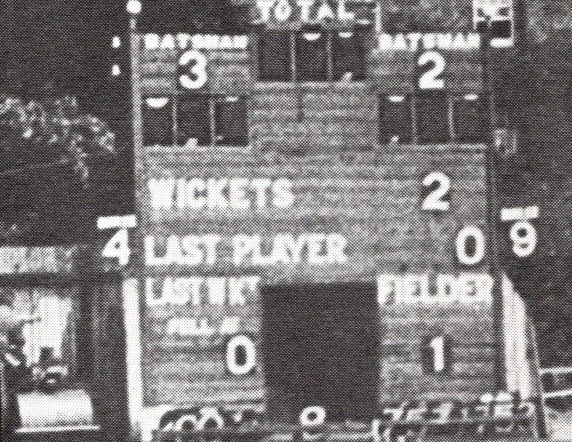
Everything about the scoreboard reflected a different era of cricket. Scores were updated manually, with operators using mirrors to check figures and climbing ladders to attach the correct tin numbers for bonus points. Even the light indicators, added later to help judge playing conditions, were added in an attempt to indicate whether the light was good enough to play or not. However, they weren’t always the most accurate!
As the years passed, the space around and beneath the scoreboard evolved too.
The old tea bar, once central at ground level, was replaced by a refreshments kiosk to the side, while additional structures were added behind to accommodate ground staff facilities and storage. For a time, rooms beneath each gable were used as offices, with figures such as coach Basil D’Oliveira, watching over proceedings from within it.
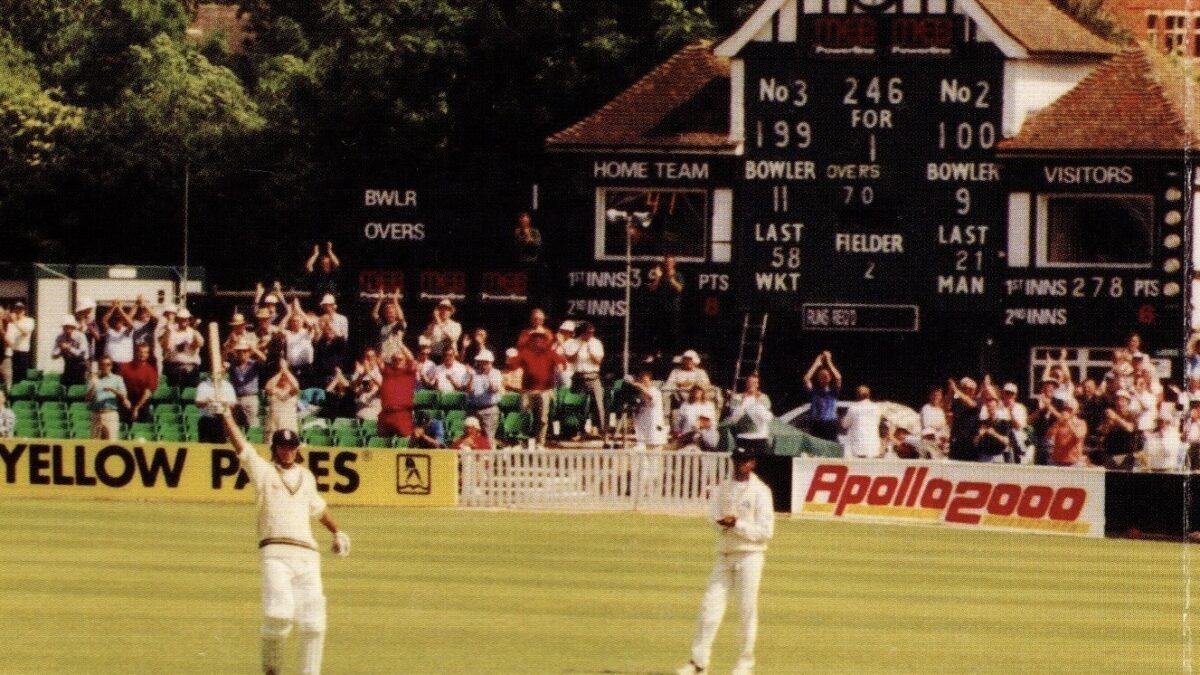
In 1998, the scoreboard captured another milestone moment as Graeme Hick completed his hundredth first-class century against Sussex, just as Vikram Solanki brought up his maiden hundred. Five years later, the scoreboard bowed out at the end of the 2003 season, when the scoring baton was passed to the newly constructed Basil D’Oliveira Stand.
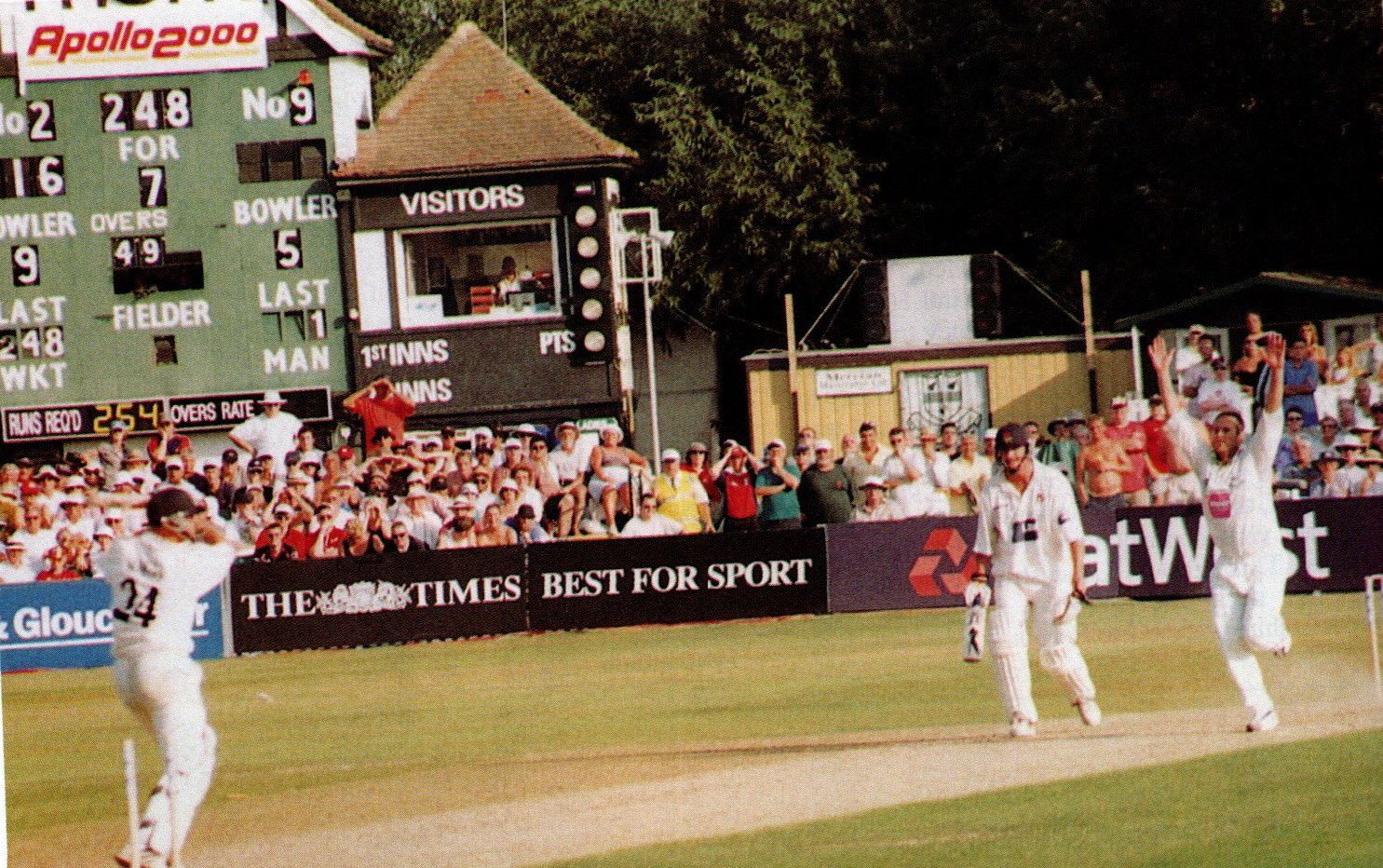
In its final season of use in 2003, the Diglis End scoreboard captured one of the most dramatic finishes in New Road history, where Andrew Hall’s devastating final over against Lancashire in the Cheltenham and Gloucester Cup semi-final saw three wickets fall and a famous Worcestershire victory secured.
For generations, the scoreboard has been part of life at New Road, recording special matchday moments. With careful restoration of the building and considered improvements to the areas around it, the Club is ensuring it continues to play a role in the supporter experience, linking the ground’s history with the future taking shape around it.